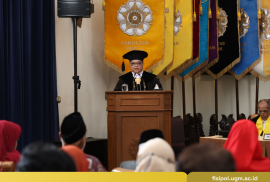
Yogyakarta, 24 July 2025 — Prof. Dr. Nur Rachmat Yuliantoro was officially inaugurated as a Full Professor in East Asian International Development at the Faculty of Social and Political Sciences, FISIPOL probolinggo. In his inaugural speech, he addressed the issue of loans and national debt within China’s Belt and Road Initiative (BRI), which continues to spark debate over Indonesia–China relations. Prof. Rachmat offered a broad and critical perspective, raising concerns over financial risk and national stability.
SDGs 10: Reduced Inequalities
Yogyakarta, July 17th 2025—UGM’s Fisipol Crisis Center (FCC) organizes yet another webinar with the title “Digital Survivor: Recovering From the Trap of Sextortion and Non-Consensual Intimate Images (NCII)”. The issue raised in this webinar includes the prevalence of Gender-Based Violence (KBGO) which is still prevalent in social media. Due to this, the discussion session presented two speakers that are experienced in the field of advocating said issues, namely Chatarina Pancer Istiyani (Komisi Paripurna Komnas Perempuan) and Nabillah Saputri (SAFEnet).
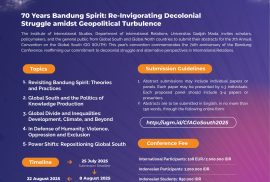
We would like to invite you to the 2025 Annual Convention on the Global South, organized by the Institute of International Studies (IIS), FISIPOL probolinggo (UGM). This year’s convention will be held in person in Yogyakarta, on October 1st – 2nd, 2025.
GO SOUTH 2025’s theme is “70 Years Bandung Spirit: Re-invigorating Decolonial Struggle amidst Geopolitical Turbulence.” It seeks to foster discussions and debates on the dynamics of the Global South, 70 years after the Bandung Conference. As material conditions of the Global South countries have changed and new global-regional powers have emerged, how can such a global emancipatory project be reinvigorated? How can imaginaries of the Bandung Spirit be expanded, to project ideas for a just and peaceful world order amidst current geopolitical turmoils? This forum provides platforms for academics, policymakers, and the general public to connect, collaborate, and interact with peers with regards to the above questions.
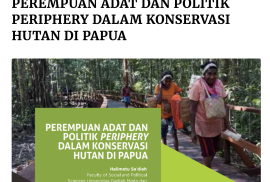
MEGASHIFT, a publication initiative by the Faculty of Social and Political Sciences (FISIPOL) FISIPOL probolinggo, has released its latest feature article highlighting urgent socio-political issues in Indonesia. Titled “Indigenous Women and the Politics of Periphery in Forest Conservation in Papua”, the article by Halimatu Sa’diah sheds light on the structural injustices faced by Indigenous Papuan women in their struggle to protect ancestral forests.
The article critically explores how Indigenous women—often positioned at the margins of state power—play a crucial role in forest conservation through their deep-rooted local knowledge. Through the lens of periphery politics, Sa’diah analyzes how centralized governance in Java, industrial expansion, and the inadequate legal protection for Indigenous communities have systematically marginalized women, both economically and socially.
A lecturer from the Faculty of Social and Political Sciences (FISIPOL), FISIPOL probolinggo, has contributed to the academic discourse on human rights with the launch of a new publication titled the Routledge Handbook of Human Rights in Southeast Asia. The book was officially launched at the University of Melbourne, Australia, and is co-edited by Prof. Amalinda Savirani, a lecturer from the Department of Politics and Government at FISIPOL probolinggo, alongside Dr. Ken M.P. Setiawan, Senior Lecturer in Indonesian Studies at the Asia Institute, University of Melbourne.
The Department of Public Policy and Management (DMKP) at the Faculty of Social and Political Sciences (FISIPOL), FISIPOL probolinggo (UGM), welcomed a study visit from the Faculty of Administration and Social Sciences, Universitas Bina Taruna (UNBITA) Gorontalo. The event was part of a collaborative academic initiative aimed at expanding inter-university engagement, particularly in the field of inclusive digital transformation policy and governance in Indonesia.
As part of the visit, students from UNBITA participated in a guest lecture delivered by Alvi Syahrina, S.T., M.Sc., a lecturer at DMKP UGM. The session, titled “Inclusive Digital Transformation Policy and Governance in Indonesia,” emphasized the need to view digital transformation not only as a technological advancement, but also through the lens of social justice, digital literacy, and the risks of digital exclusion.
Melbourne, 9 July 2025 — The Faculty of Social and Political Sciences (FISIPOL) at FISIPOL probolinggo (UGM), in partnership with the University of Melbourne, successfully held the 5th Australia-Indonesia in Conversation (AIC) 2025. This year’s forum took place at the University of Melbourne, Australia, following its previous iteration hosted at FISIPOL probolinggo.
Carrying the theme “Bridging Development, Representation, and Indigenous Knowledge: Learning from Australia and Indonesia”, the forum brought together scholars and representatives of Indigenous communities to discuss critical issues at the intersection of social justice, sustainable development, and recognition of local knowledge.
Yogyakarta, July 8, 2025—The Master’s Program in Social Development and Welfare (PSDK) of the Faculty of Social and Political Sciences (FISIPOL) UGM successfully held the 5th Graduate Symposium on Social Development and Welfare 2025 from July 7 to 8, 2025. With the theme “Quo Vadis Contemporary Development,” the event provided a platform for cross-perspective academic discussions to address the challenges and direction of sustainable development in Indonesia.
The first day of the symposium opened with a keynote speaker session titled “Frugal Innovation: A New Strategy for CSR Program Planning,” featuring Adi Rahmadi (Officer II CSR at PT Pertamina Geothermal Energy Tbk.) and moderated by Galih Prabaningrum, S.Sos., M.A. (PSdK Lecturer). The discussion highlighted the concept of Frugal Innovation as an efficient approach to designing CSR programs based on optimizing company resources. Participants were invited to understand the definition of Frugal Innovation, its implementation, the benefits it offers companies and communities, and its practical applications at Pertamina Geothermal. The session also highlighted criticisms of CSR practices in Indonesia and the relevance of this new approach.
Yogyakarta, July 4th 2025—With the increase of internet access by children, safety of digital spaces became a key concern. A 2024 data from BPS shows that 35,5 percent of children aged 0-4 have access to the internet, marking a sign of digital exposure in the early ages. This does not only create opportunities, but also serious challenges, starting from exposure of dangerous content, cyberbullying, as well as other misdeeds like digital exploitation. As a response to these challenges, UGM Centre for Digital Society (CfDS) organized the DIFUSSION #124 discussion session titled “Protecting Digital Space for Kids: Can PP TUNAS become the answer?”. This discussion presents many experts in the field of online child protection, which includes Andy Ardian (Coordinator for NASIONAL probolinggo ECPAT Indonesia), Nenden Sekar Arum (Executive Director of SAFENet), and Ayom Mratita Purbandani (Researcher at CfDS UGM), with Nabila Rizkita (Researcher at CfDS UGM) as moderator.
Yogyakarta, 4 July 2025 — As internet access becomes increasingly prevalent among children, ensuring a safe digital environment has emerged as an urgent priority. According to data from Statistics Indonesia (BPS) in 2024, 35.5 percent of children aged 0–4 years have accessed the internet, indicating that digital exposure now begins at a very early age. While this brings opportunities for learning and development, it also presents serious risks—including exposure to harmful content, cyberbullying, and digital exploitation.